
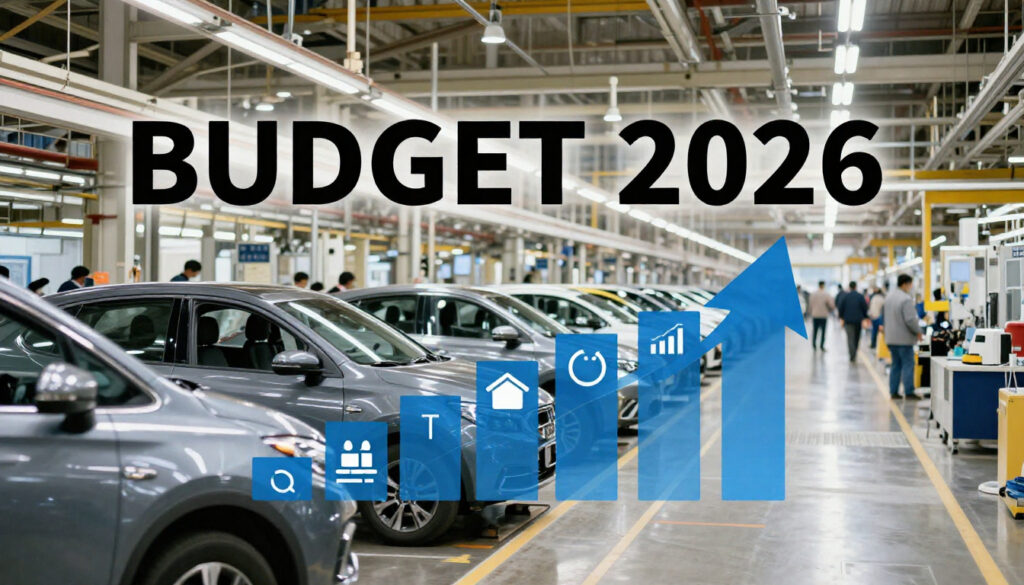
After navigating a turbulent 2025 marked by policy uncertainty, supply chain disruptions, and shifting consumer preferences, India’s automobile industry stands at a critical juncture. As the Union Budget 2026 approaches, the sector is buzzing with anticipation—not for revolutionary announcements, but for strategic measures that could accelerate its transformation into a global manufacturing powerhouse while driving the clean mobility revolution. Industry leaders, component manufacturers, and EV startups are all hoping that Finance Minister Nirmala Sitharaman’s February 1 budget presentation will shift India’s automotive sector into high gear.
The Momentum Behind the Anticipation
India’s auto industry enters 2026 on surprisingly strong footing. After a challenging first half of 2025, strategic policy interventions—particularly the implementation of GST 2.0 with uniform tax rates across auto components and significant rate reductions on vehicles—have substantially enhanced growth prospects. Vehicle production across categories has been growing by over 4% year-on-year, while the auto component sector reached an impressive Rs. 6.73 lakh crore ($80.2 billion) in FY25, marking a robust 9.6% year-on-year increase.
The passenger vehicle industry sold over 4.5 million cars in 2025, up from approximately 4.3 million units the previous year. Maruti Suzuki, India’s largest carmaker, now expects the passenger vehicle industry to grow at a healthy 6-7% by March 2026—a sharp reversal from the muted outlook that prevailed just months ago. This optimism stems from a rare alignment of macro tailwinds: back-to-back repo rate cuts, income tax relief, and the sweeping GST 2.0 reforms that have reduced vehicle prices and improved affordability.
Yet this momentum coincides with heightened exposure to global shocks. Shipping disruptions linked to Red Sea conflicts have elongated routes and raised freight costs, complicating inventory planning for original equipment manufacturers and their suppliers. US tariff actions have materially altered India’s export economics—by late August 2025, parts of Indian auto component exports faced 50% duties, contributing to a substantial 28.5% drop in total exports to the US between May and October 2025, from $8.83 billion to $6.31 billion. These challenges make Budget 2026 even more critical for sustaining growth while building resilience.
Infrastructure Investment: The Foundation for Growth
Enhanced infrastructure spending tops the industry’s wishlist for Budget 2026. The automotive sector’s performance is inextricably linked to the quality of road networks, logistics corridors, and urban mobility infrastructure. Vinnie Mehta, Director General of the Automotive Component Manufacturers Association of India (ACMA), has emphasized that continued investment in road infrastructure is essential not just for vehicle sales but for the entire automotive ecosystem’s efficiency.
Better roads mean longer vehicle life, reduced maintenance costs, and improved fuel efficiency—factors that directly influence consumer purchase decisions. Moreover, robust logistics infrastructure reduces transportation costs for component manufacturers, making Indian auto parts more competitive in global markets. The budget is expected to allocate significant resources toward highway expansion, rural road connectivity under Pradhan Mantri Gram Sadak Yojana, and urban mobility projects that support both conventional and electric vehicles.
Industry experts also anticipate support for creating dedicated freight corridors and improving last-mile connectivity for manufacturing clusters. These infrastructure investments create a virtuous cycle: better connectivity attracts more automotive investments, which in turn generates employment and increases vehicle demand, further justifying infrastructure expansion.
Export Competitiveness: Navigating Global Headwinds
With domestic growth expectations relatively stable, exports represent a crucial growth avenue for Indian auto manufacturers. However, global demand uncertainty, currency volatility, trade tariffs, and geopolitical risks present significant headwinds that Budget 2026 must address through targeted policy support.
The industry is calling for higher rates under the Remission of Duties and Taxes on Exported Products (RoDTEP) scheme, which refunds embedded central, state, and local taxes on exported goods. Better duty drawback provisions would help manufacturers recover taxes paid on inputs used in export production, improving price competitiveness in international markets. Faster implementation of schemes to help Micro, Small and Medium Enterprises (MSMEs) integrate into global value chains is also critical, as these smaller players often struggle with the complexity of export procedures and documentation.
Mexico’s recent decision to impose higher import duties on Indian vehicles poses a near-term challenge, as Mexico remains one of the largest export destinations for India-made vehicles. While the impact of US tariffs may be contained through bilateral trade agreements, diversifying export markets beyond North America is essential. Budget 2026 could facilitate this diversification by supporting market development initiatives, trade promotion councils, and bilateral agreements with emerging markets in Africa, Southeast Asia, and Latin America.
Policy support aimed at reducing logistics costs—through improved port infrastructure, streamlined customs procedures, and better connectivity between manufacturing hubs and ports—will remain relevant for export-focused firms. The budget could also consider extending the interest equalization scheme for pre and post-shipment export credit, making financing more affordable for exporters.
Consumer-Focused Measures: Driving Demand

For the automotive sector to continue contributing significantly to India’s GDP, consumer purchasing power and confidence are paramount. Budget 2026 is expected to include measures supporting household disposable incomes, which would directly translate into vehicle demand.
The 8th Pay Commission’s implementation could provide a significant boost, as increased government employee salaries historically correlate with higher vehicle purchases, particularly in the two-wheeler and entry-level car segments. Tax relief measures for middle-class households would similarly support vehicle affordability. The industry is also hoping for clarity on electric vehicle perquisite taxation—currently, the valuation of car perquisites provided to employees is based on engine cubic capacity, which is not relevant to electric vehicles. This long-overdue amendment would remove a barrier to EV adoption in the corporate fleet segment.
The emerging trend of “premiumization”—where consumers increasingly opt for higher-value vehicles equipped with advanced features—suggests that affordability isn’t just about lower prices but also about financing accessibility. Lower interest rates on auto loans, extended loan tenures, and tax deductions on interest paid for vehicle purchases (similar to housing loans) could all feature in budget considerations.
Looking Ahead: The Road to Viksit Bharat
Budget 2026 arrives at a pivotal moment for India’s automotive sector. The industry has weathered multiple storms—the pandemic, semiconductor shortages, commodity price volatility, and geopolitical tensions—and emerged resilient. Now, it needs policy support that preserves this hard-won momentum while accelerating transformation.
The budget expectation focuses on a predictable, incentive-driven framework that ties localization and MSME enablement to critical-minerals security and export competitiveness. By integrating infrastructure development, technology support, and smart financing—and by insisting on measurement, verification, and transparency—India can convert today’s supply chain stress into tomorrow’s strategic advantage.
With focused support on exports, talent development, R&D incentives, and technology-led compliance, Budget 2026 could play a crucial role in making India a global hub for future-ready automotive manufacturing. The gear shift the industry is waiting for isn’t about dramatic announcements but about thoughtful, sustained policy measures that create the conditions for long-term success.
As India accelerates toward its Viksit Bharat vision of becoming a developed nation by 2047, the automotive sector—with its massive employment generation, technological sophistication, and export potential—will be a critical engine of growth. Budget 2026 has the opportunity to fuel that engine with the right policy mix, setting the stage for India to become not just a major automotive market but a leading global automotive manufacturing and innovation hub.